

THE URBAN EXPOSOME
BUILDING HEALTHIER, AGE-FRIENDLY URBAN AREAS THROUGH EXPOSOME RESEARCH
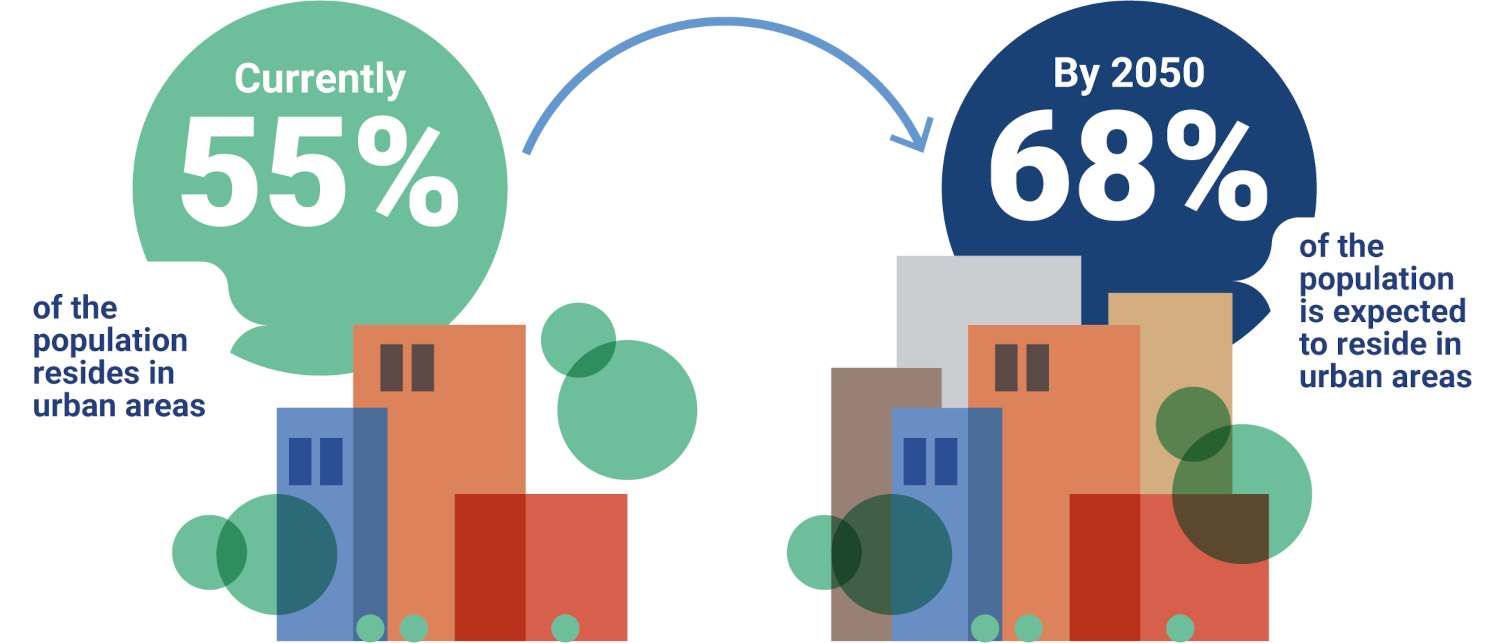

WHAT IS AN URBAN AREA?
An urban area is a city or town and its surrounding areas e.g., the suburbs. Urban areas are very developed and include houses, commercial buildings, roads, bridges, and railways, as well as high population density.²
Urban Living and Healthy Ageing
Understanding the Exposome

Climate change is adding another dimension to the urban exposome. Europe is the fastest-warming WHO region, with extreme heat posing a growing risk to health.⁸ In cities, the urban heat island effect, where densely built environments and limited vegetation contribute to higher temperatures, can intensify this risk. Older people can be particularly vulnerable to extreme heat, with chronic health conditions, reduced mobility and social isolation further increasing the risk.⁹
Challenges in Studying the Urban Exposome

Data Complexity

Context

Health Inequities
Whilst the challenges remain, advances in exposome science, allow us to now analyse not just a single exposure factor, but a mosaic of exposures. Thanks to high-resolution maps, personal sensors, and big data analysis, we can now more precisely monitor exposures such as pollution, noise, heat, the food environment and the presence of green spaces, and their impact on health. These data can also help identify where urban interventions are most needed and monitor their impact over time.
The TALEA project in Bologna, for example, uses data from sensors, remote sensing and citizen science to support the development and monitoring of a network of ‘Green Cells’.¹⁰ These use vegetation and nature-based solutions to provide relief during heatwaves, while also supporting biodiversity, sustainable mobility and social interaction.
Tools such as the NEXI Proximity Index¹¹, inspired by the 15-minute city model, and the new high-resolution European Walkability Index¹² help measure urban quality and design healthier, more accessible, and more sustainable cities.
In the STAGE project, we are developing AI-powered risk prediction models that account for a wide range of exposure factors in relation to health outcomes, such as multi morbidity in older adults. The models bring together medical history, lifestyle habits, and a wide variety of environmental exposures. This rich combination of data will allow us to paint a fuller picture of an individual’s health, predict how multiple diseases might progress together, and facilitate personalised care. The goal is to generate evidence that can help healthcare providers, policymakers, researchers and citizens better understand health risks, act earlier and support healthy ageing.
Initiatives Tackling Urban Health Challenges

Amid the complexities and varied challenges of enhancing urban health, numerous global and regional initiatives are forging paths towards more sustainable and healthier urban living.
The WHO Healthy Cities Network works to elevate health on the political and social agendas of cities, focusing on equity, participatory governance, and local-level public health movements while emphasising intersectoral collaboration to address determinants of health.
The Green City Accord, an initiative by the European Commission, represents a commitment by European mayors to promote cleaner and healthier cities, aiming to enhance the quality of life for all Europeans and accelerate the implementation of relevant EU environmental laws.
Meanwhile, Eurocities fosters a platform for cities across Europe to exchange insights and strategies, addressing urban challenges with key aims such as establishing healthy, prosperous, and inclusive cities, mitigating air, water, and noise pollution, promoting clean mobility, and amplifying citizen engagement.
These initiatives highlight the vital role of policy, community involvement, and city collaboration in moving toward healthier urban living, which complements and aligns with exposome research.
There are also environmental initiatives dedicated to healthy ageing. The Global Network of Age-friendly Cities and Communities, which involves more than 1,800 cities and communities in 60 countries working to improve their physical and social environments to become better places in which to grow old, has seen a rapid growth in membership. One of the four enablers in the UN Decade of Healthy Ageing (2021–2030) is creating age-friendly environments. The WHO European Region Ageing is Living Strategy (2026–2030) is expected to be adopted in October 2026, with one of the four core areas focused on creating enabling environments.
Despite the many initiatives, monitoring and evaluating the outcomes and impact remains challenging and understudied.¹³
Shaping Healthier Urban Environments
The STAGE project is one example of how European research is redefining the way we understand the link between cities, the environment, and health. One key output which will support that understanding is an Age-Friendly Neighbourhood Atlas. Under development, this online, Europe-wide map will enable users to visualise, examine and compare the healthy and active ageing potential of areas.
The urban exposome reminds us that health is associated with many aspects of our environment. Translating exposome research into effective urban health policies can be challenging yet hugely powerful. By combining science, public policies, and democratic data management, we can build cities that not only reduce disease but also generate health, equity, and sustainability for all.
RESOURCES
¹ World Health Organization, Urban Health Fact Sheet https://www.who.int/news-room/fact-sheets/detail/urban-health
² National Geographic https://education.nationalgeographic.org/resource/urban-area/
³ Fear of Falling and Environmental Factors: A Scoping Review. Ann Geriatr Med Res (2022) 26(2):83–93. https://doi.org/10.4235/agmr.22.0016
⁴ World Health Organization News Release https://www.who.int/news/item/11-12-2010-who-launches-global-network-of-age-friendly-cities
⁵ The International Human Exposome Network https://humanexposome.net/
⁶ Mette Sørensen, Ulla Arthur Hvidtfeldt, Aslak Harbo Poulsen et al. Long-term exposure to transportation noise and risk of type 2 diabetes: A cohort study. Environmental Research, Volume 217, 2023, 114795, ISSN 0013-9351. https://doi.org/10.1016/j.envres.2022.114795.
⁷ Althoff, T., Ivanovic, B., King, A.C. et al. Countrywide natural experiment links built environment to physical activity. Nature 645, 407–413 (2025). https://doi.org/10.1038/s41586-025-09321-3
⁸ World Health Organization Regional Office for Europe. Heatwaves. WHO Europe. https://www.who.int/europe/health-topics/heatwaves
⁹ Fastl, C., Arnberger, A., Gallistl, V., Stein, V.K. & Dorner, T.E. (2024). Heat vulnerability: health impacts of heat on older people in urban and rural areas in Europe. Wiener Klinische Wochenschrift, 136, 507–514. https://doi.org/10.1007/s00508-024-02419-0
¹⁰ European Urban Initiative. TALEA – Green Cells Leading the Green Transition: Bologna. https://www.urban-initiative.eu/ia-cities/bologna/about-projects
¹¹ Beatrice Olivari, Piergiorgio Cipriano, Maurizio Napolitano, Luca Giovannini. Are Italian cities already 15-minute? Presenting the Next Proximity Index: A novel and scalable way to measure it, based on open data. Journal of Urban Mobility, Volume 4, 2023, 100057, ISSN 2667-0917, https://doi.org/10.1016/j.urbmob.2023.100057.
¹² Nishit Patel, Hoang-Ha Nguyen, Jet van de Geest, Alfred Wagtendonk, Mohan J.S. Raju, Payam Dadvand, Kees de Hoogh, Marta Cirach, Mark Nieuwenhuijsen, Thao Minh Lam, Jeroen Lakerveld. A Walk across Europe: Development of a high-resolution walkability index. Health & Place, Volume 96, 2025, 103544, ISSN 1353-8292, https://doi.org/10.1016/j.healthplace.2025.103544.
¹³ Xu, W., Zechner, M., Viknaraj Sivabalan, T., Low, L. L., Shon, C., Chen, H., Reuter, A., Turner, D., Tiilikainen, E., Kiyota, E., & Iwarsson, S. (2025). Towards evidence-based approaches to monitoring and evaluating age-friendly cities and communities: Reflections from the Western Pacific and Nordic Regions. Urban Studies, 0(0). https://doi.org/10.1177/00420980251375852
¹⁴ Scientific Foresight Unit (STOA) EPRS | European Parliamentary Research Service. Human exposome research – Potential, limitations and public policy implications.
https://www.europarl.europa.eu/RegData/etudes/STUD/2025/765791/EPRS_STU(2025)765791_EN.pdf